eCommerce
Magento 2 implementation
for the Argip B2B store
Argip is a distributor of fasteners - such as screws and washers - operating in a B2B model. The assortment includes over 80,000 items, of which as many as 60,000 are configurable products.
Scope of work
B2B development
Key features
Magento 2, Pimcore, UX design
Industry
Construction
Year of implementation
2025
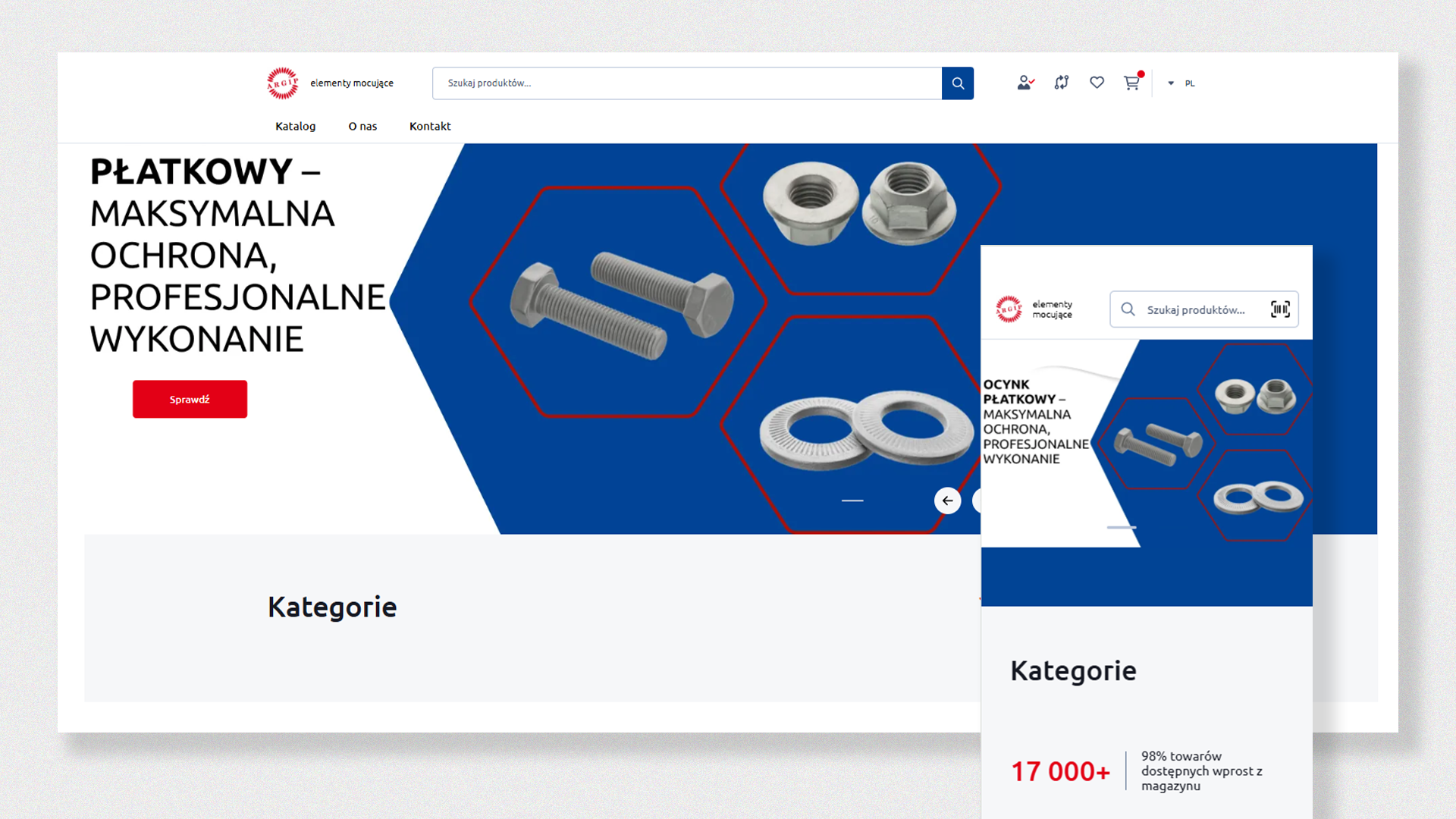
The priority when designing the service was to enable customers to place orders efficiently – not through classic catalog browsing, but via fast product search by OEM numbers and packaging units. This goal directly influenced the platform architecture and the UX solutions used.
Project goals:
- Organizing and centralizing product data and reducing technology debt
- Reflecting real B2B processes and improving the everyday work of business clients
- Increasing the efficiency and predictability of the purchasing process
Scope and timeline of the project
Currently, due to the migration of customer accounts, both the older and the newer version of the store are in operation.
The project was executed from scratch. The scope covered the full implementation cycle: from analysis and UX design, through development, PIM and integration implementation and DevOps activities, up to providing SLA support.
The goal was to reduce technology debt and prepare the Pimcore structure as the central source of product data (including structures such as matrices and product categories).
The client received the first tools enabling the long-term organization of the product database 6 months after the start of the cooperation. The “go-live” date for the entire platform was planned for 18 months after the work began.
The following functionalities were implemented as part of the project:
- Integration of Magento 2 with Pimcore as the central source of product data.
- Dynamic retrieval of prices and stock levels from ERP for each order.
- Automatic calculation of delivery costs by the ERP system, with a fallback mode in case of no response.
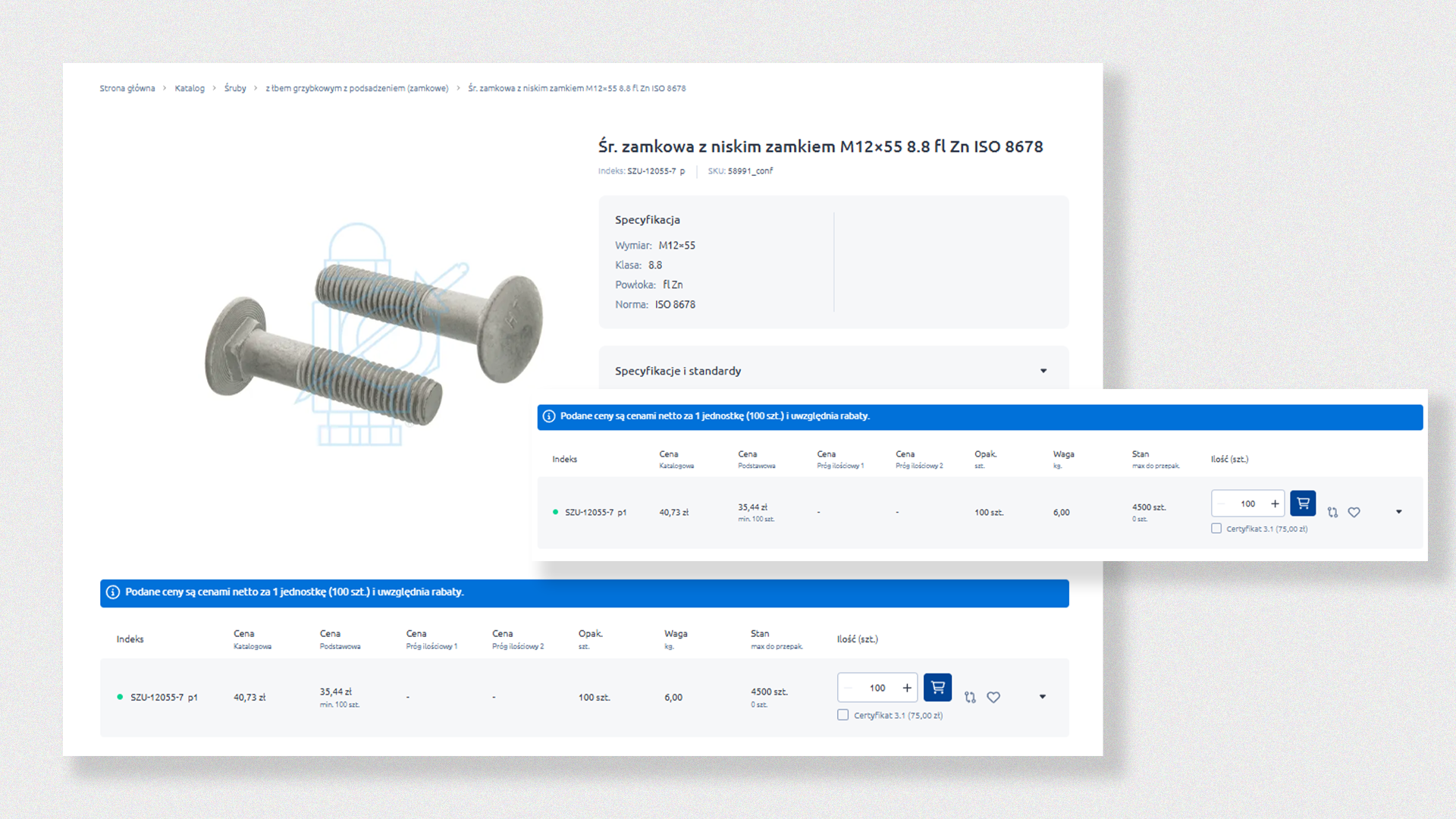
- Automatic price recalculation per 100 pieces for fully consistent comparisons.
- Automatic splitting of orders when the cart contains both ready-made products and those requiring repackaging.
- Dynamic cart validation every minute, detecting changes in prices and stock levels.
- Alert system (red/yellow) requiring order confirmation after data changes.
- Product search by indexes, variants, units and packaging codes.
- The “Your SKUs” feature enabling contractors to assign their own codes to products, plus a search engine that recognizes and supports customers’ own SKUs.
- Generation of product matrices and similarities based on rules in the PIM.
- EAN code scanning from mobile devices for fast cart building.
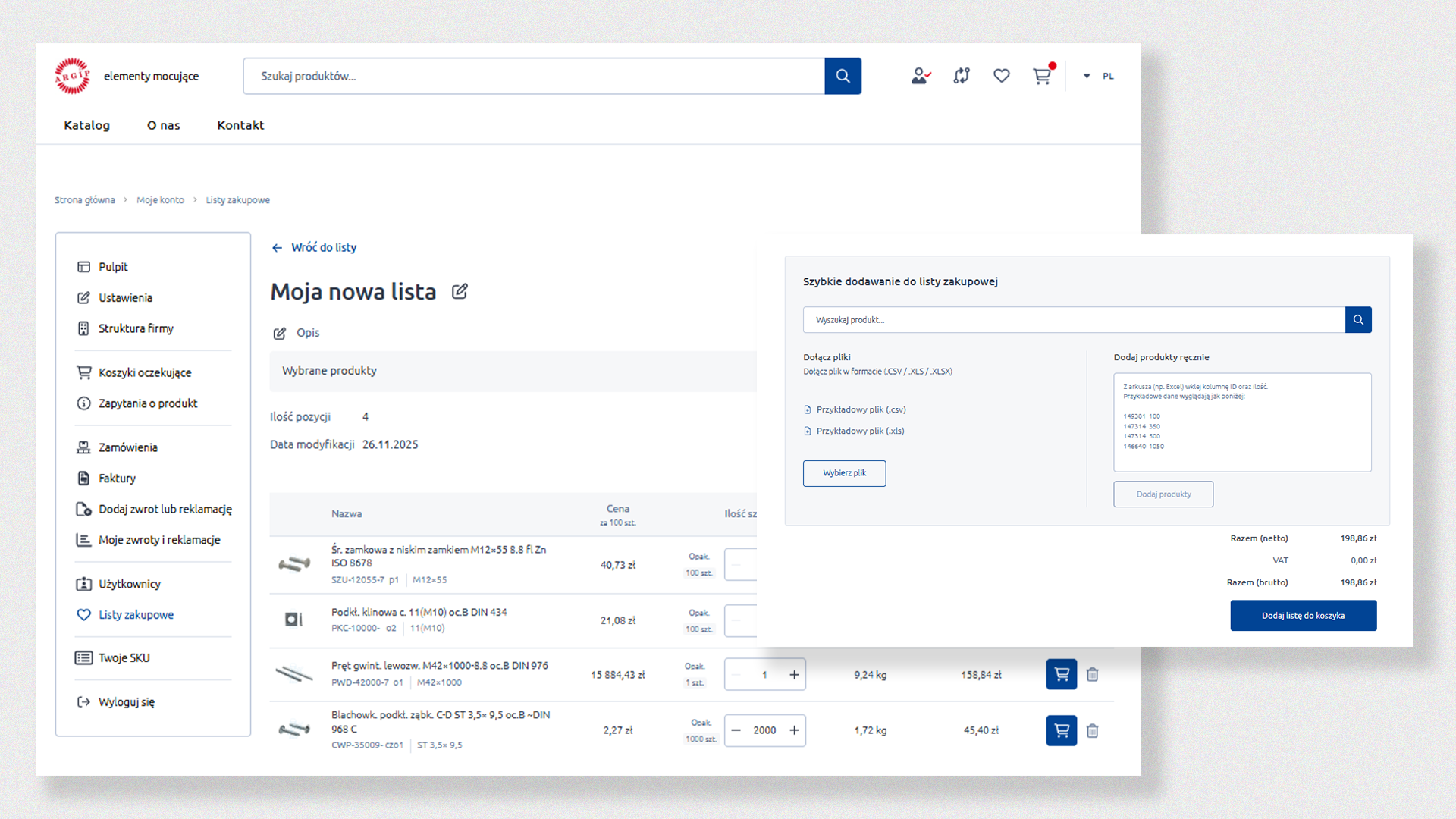
- Multi-cart functionality enabling saving multiple sets of items.
- Customer account structure reflecting the company’s head office and branches.
- Separate delivery addresses, user roles and permissions, and insight into credit limits and document history – all in the contractor panel.
- Backup policy with the ability to restore “to a point in time”.
- Service structure optimized for AI crawlers and next-generation search engines.
From concept to implementation
The technological core of the implemented solution is Magento 2 with a frontend built on ScandiPWA components. The product system and its categorization are handled by Pimcore, while Docker is responsible for environment containerization.
A key integration is the connection with the ERP system, which calculates delivery costs in real time based on the cart contents. In case of no response from the ERP, a controlled fallback mechanism is triggered, generating a default delivery cost – this ensures continuity of the purchasing process and prevents blocking order finalization. In the next step, the delivery cost is manually configured by a store employee “offline”. As a result, even in the event of an outage, the customer can place an order.
At the architecture design stage, the client deliberately abandoned integration with online payments and courier systems. The priority was to reliably reflect B2B processes and organize the product data structure. After the production go-live, full data synchronization between Pimcore and Magento was launched.
In addition, we implemented a range of other technological solutions, such as:

implementation of Google structural guidelines and optimization for AI crawlers

prices and stock levels are cyclically verified in the shopping cart

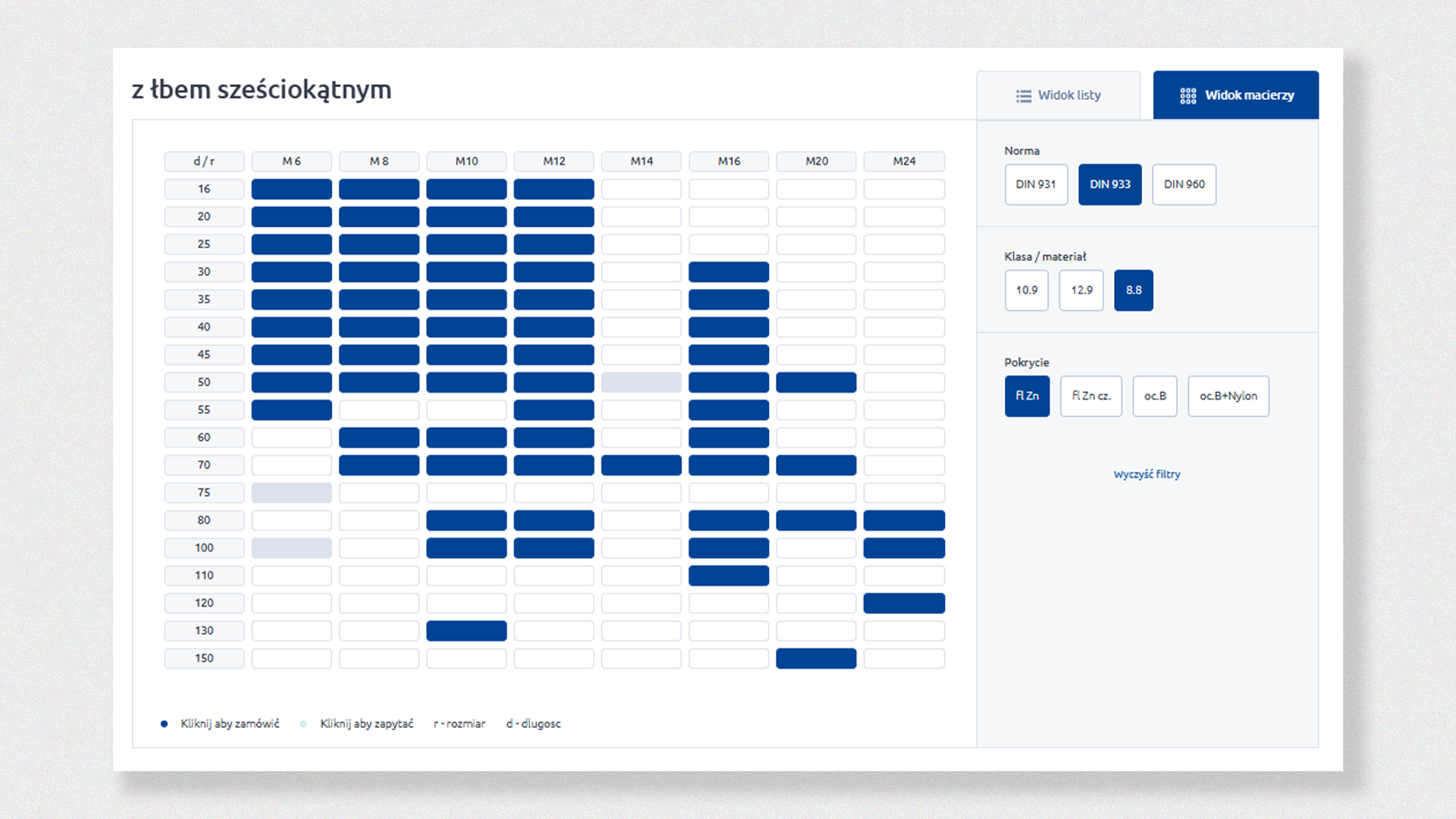
if a given product is unavailable, the customer can conveniently choose a similar item from a product matrix

the ability to add a product to the cart by scanning the EAN code with a phone

the ability to restore the store version to a specific “point in time”

implementation of real-time synchronization between Magento, PIM and ERP
As part of maintenance, we implemented SLA support, including IT administration, service monitoring and instance management, as well as a full backup policy with the option to restore the database “to a point in time”. Before the official launch of the store, we also carried out load tests, index verification and security scans of the servers based on OpenVAS.
Importantly, even before the production launch, the client maintained active synchronization between ERP and PIM for over half a year, both on stage and pre-prod environments. This made it possible to detect potential bottlenecks earlier and streamline the implementation process.
UX supporting purchase, not just “browsing”
Most Argip customers are industry professionals who come to the site with a clearly defined goal. They already know the product indexes and their variants, so the store is not focused on upsell or cross-sell - a direction the client deliberately chose to forgo at the time of implementation. This purchasing model drives specific UX design decisions. The interface’s main purpose is to enable fast and convenient purchasing.
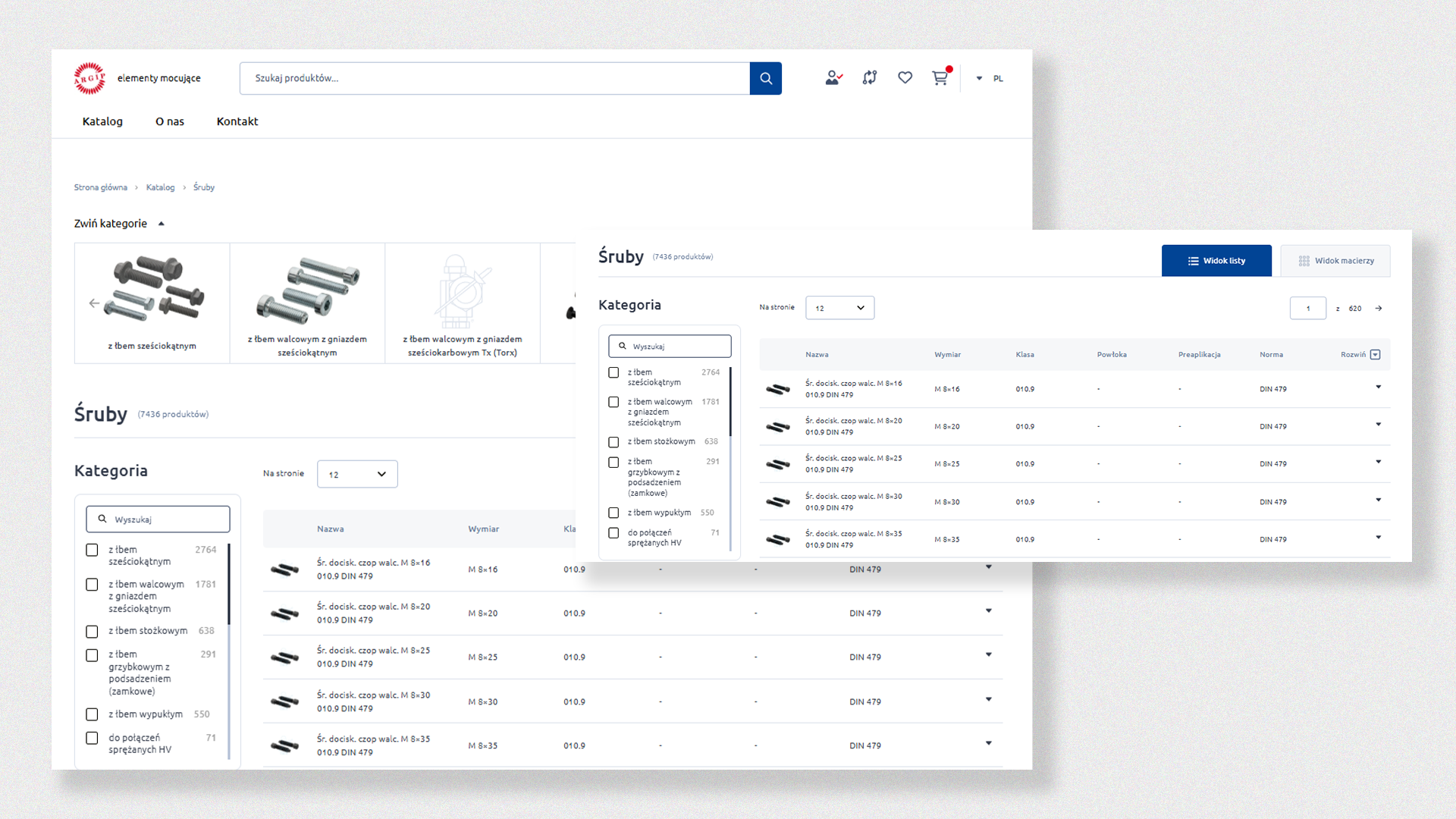
The structure of the product listing is based on the logic: base product + packaging variants. Additionally, the price is always recalculated per 100 pieces, and the minimum purchase unit is a multiple of packages (25, 50, 250, etc.) – with the option to add only that minimum number of products to the cart.
Argip operates with two stock types: products ready for sale (i.e. packaged) and those that require repackaging. They differ in lead time, so the system automatically splits the order if the cart contains both types of goods. Repackaging takes a maximum of 7 business days, which allows precise calculation of the delivery date.
Part of the assortment is available only in full pallets – this directly reflects the realities of B2B logistics, where retail single-unit sales do not apply.
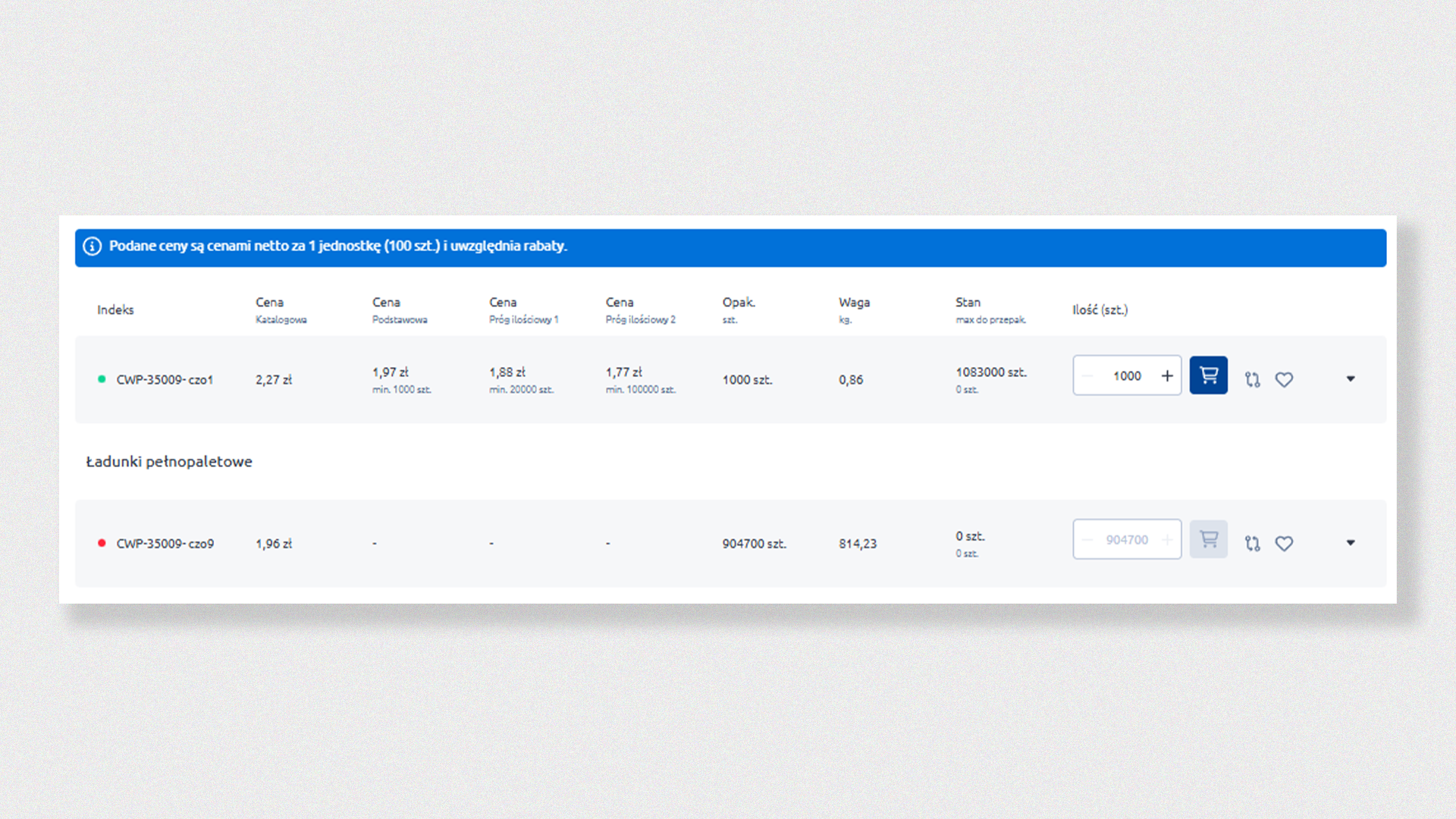
An important element of the store architecture is also dynamic cart validation – every minute the system verifies both the availability and prices of products. In case of changes, the user receives a clear message: a red alert when the product is unavailable, and a yellow one when the price changes. In both situations, they are asked to confirm the order. This way, the customer always has up-to-date product information and won’t be surprised at checkout.
All of the above solutions were implemented with the goal of minimizing discrepancies between the data in the store and the status in the ERP system. The result? A predictable purchasing process that meets the expectations of business customers.
Another critical aspect is the work of the Customer Service team, which operates on the same platform. Orders are processed in exactly the same way, which makes the CS staff true experts in using the tool and also well-trained testers.
The client also required a fast “log in as customer” process, integrated with the CRM via API. In line with the client’s policy, every customer using the B2B platform is automatically rewarded with an additional discount. That discount is automatically removed if Customer Service places orders or prepares quotes on the customer’s behalf, and the customer is clearly informed about this through updated notifications.
Customer convenience first
In the B2B purchasing model, time and precision matter. That is why in Argip we implemented a set of functionalities that simplify the ordering process – for both purchasing departments and operational staff.
One of the key features is the so-called “Your SKUs” – the ability to tag products with the customer’s own internal item codes. Contractors can assign their internal codes to Argip’s offer, which are then handled by the search engine on par with original indexes. Importantly, the system also recognizes configurable products and immediately suggests a specific variant, ready to be added with a single click.
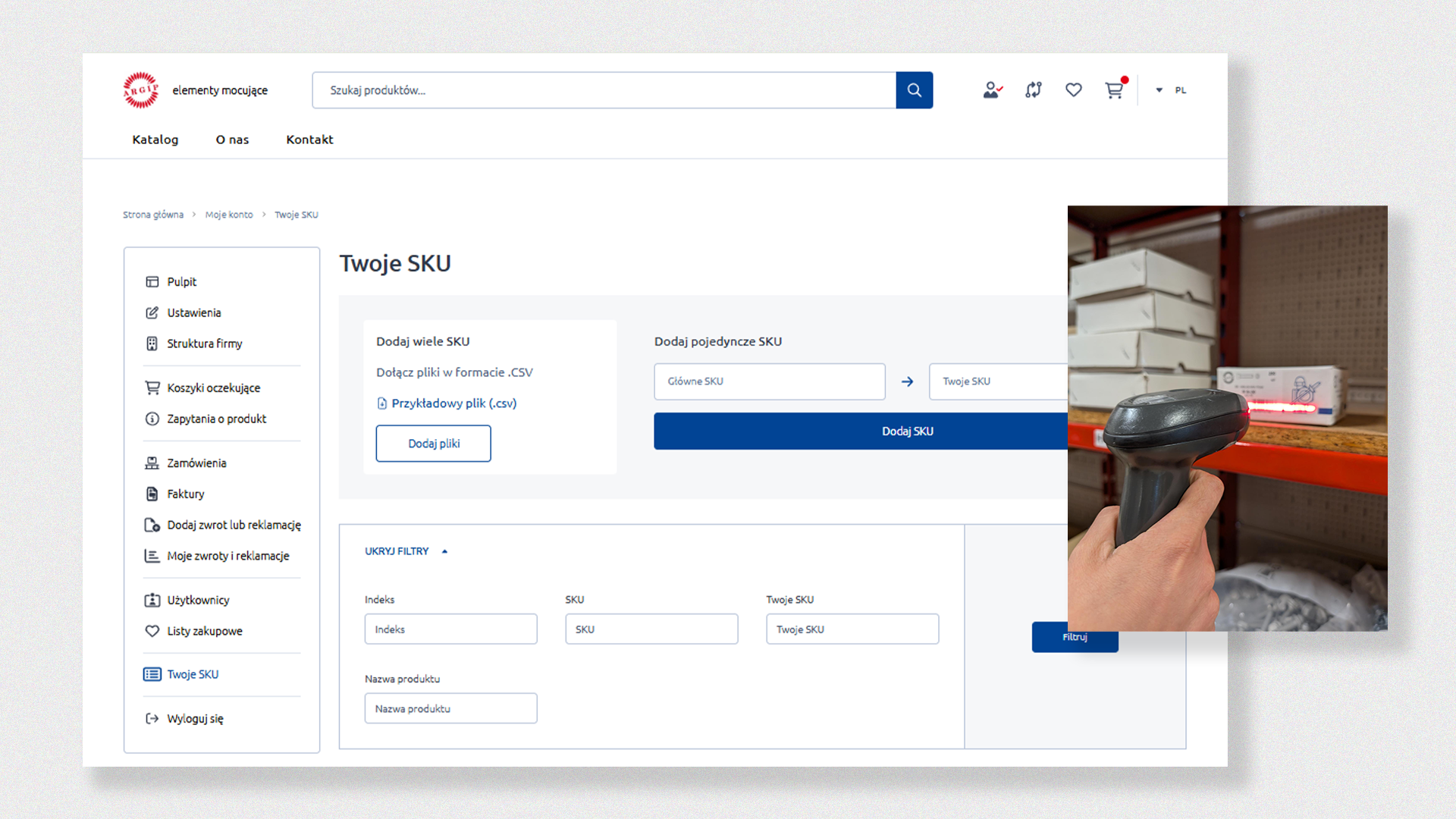
In the context of warehouse work, the EAN code scanning function is particularly important. Thanks to it, the user – using a mobile device – can quickly scan subsequent products and build an editable shopping list from them. This intuitive solution significantly facilitates ordering missing products by the contractor.
The store’s integration with the PIM system enables the creation of product matrices. Based on similarity rules, the system groups products into logical sets and makes them available in the form of tags or filters. For the user, this means quick selection of alternatives – without having to search the entire category again.
The store also supports planning and repeatability of orders. Users can create shopping lists, save carts and reuse ready-made sets of items multiple times (so-called multi-carts). This feature significantly speeds up cyclical purchases, typical for the B2B model.
When the demand exceeds current stock levels, the customer can submit an inquiry directly from the product page. Instead of sending separate messages or calling, they follow an organized contact path – which speeds up the response and increases its relevance.
A seemingly small but practically important detail in the purchasing process is the “Change” button in the order summary, which allows users to quickly return to the cart and adjust data – without resetting the entire process.
Contractor zone reflecting the company’s organizational structure
In B2B, eCommerce effectiveness does not only depend on the offer – the system’s ability to reflect the client’s internal processes is just as important. The Argip store was designed so that the customer account structure fully corresponds to the company’s actual organization.
Each contractor account includes a division into head office and branches – with separate delivery addresses assigned to each. Thanks to this, each order can be fulfilled independently, in line with the local needs and responsibilities of individual units.
An extensive system of roles and permissions enables precise control of the purchasing process. Users can have different roles – for example, one person builds the cart and another approves and finalizes the order. This division of responsibilities translates into greater control and compliance with the company’s internal purchasing policy.
The contractor’s panel also includes key financial information: credit limits, balance of unpaid invoices and full history of documents issued in the ERP system. This enables ongoing budget monitoring and facilitates cooperation with the accounting department.
The complaint module (RMA) is linked directly to invoices – therefore, each reported issue is associated with a specific sales document, which significantly speeds up handling.
As a result, the Argip online store is both a sales channel and a tool for managing relationships with business customers. This translates into greater predictability, control and comfort on the user’s side.
Performance, SEO and accessibility
In cooperation with an SEO agency, we developed a consistent information architecture in line with current Google guidelines – both in terms of URL structure and the hierarchy of headings, metadata and category logic. An important goal from the client’s perspective was to ensure visibility in classic search results and to adapt the service to the growing role of bots based on artificial intelligence.
At the technical testing stage, we confirmed that AI agents (especially crawlers used by language models) can correctly index, interpret and map the structure of the service. This means that product data, descriptions and attributes are readable for them and can be used, for example, in answers generated by AI-first search engines.
Optimization included, among others, avoiding duplicate content, proper structural markup and control over which resources are indexed and which are not. As a result, the service is well prepared both for traditional SEO and for next-generation algorithms.
Summary
When handling such a specific assortment at scale, it was crucial to use a system that offers broad possibilities for expansion and does not impose technological limitations. The choice of Magento (a platform with open-source code and flexible architecture) enables further growth without a functional “ceiling”, ensuring that the solution can evolve with the business and be adapted to new operational requirements.
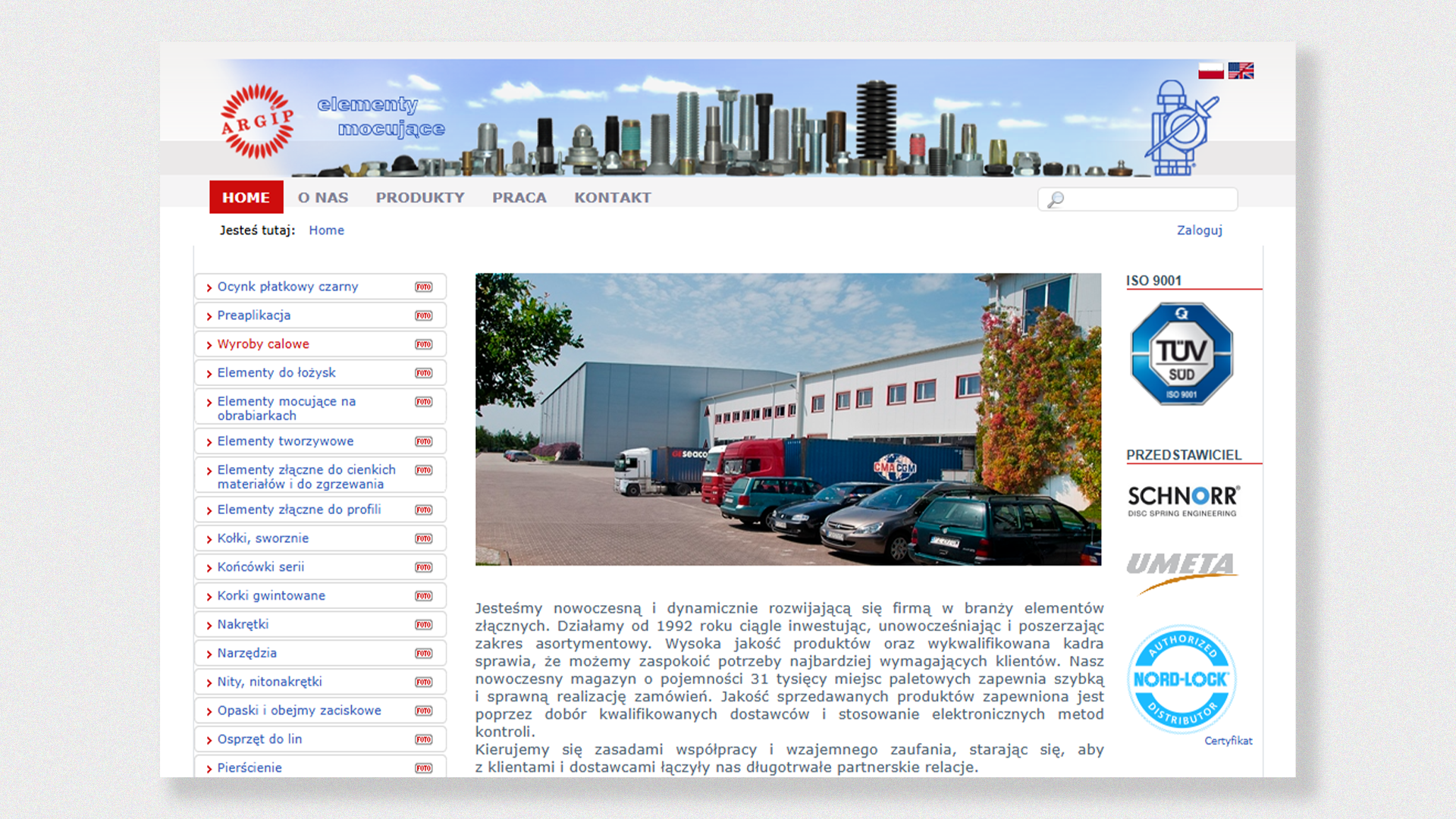
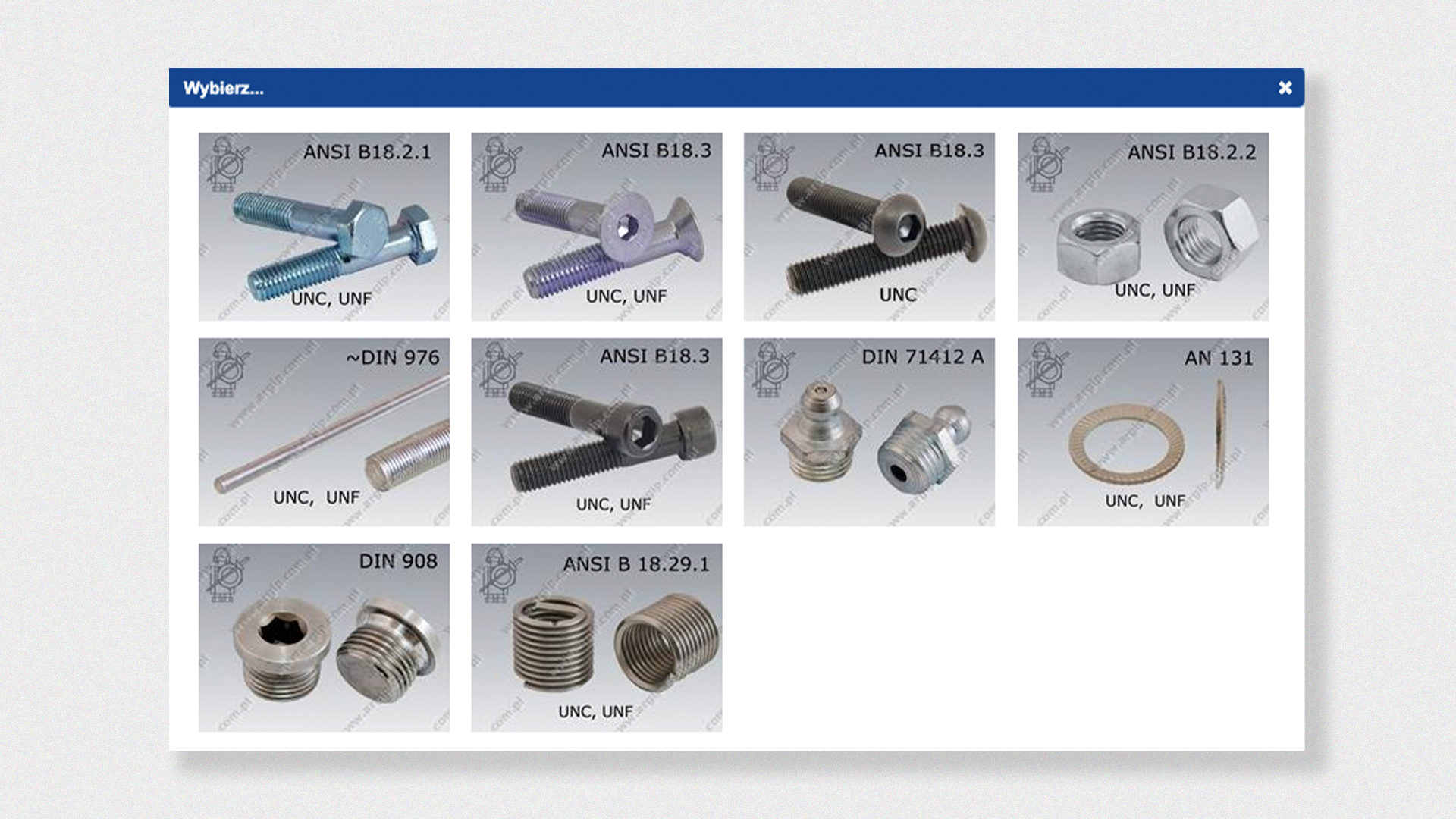
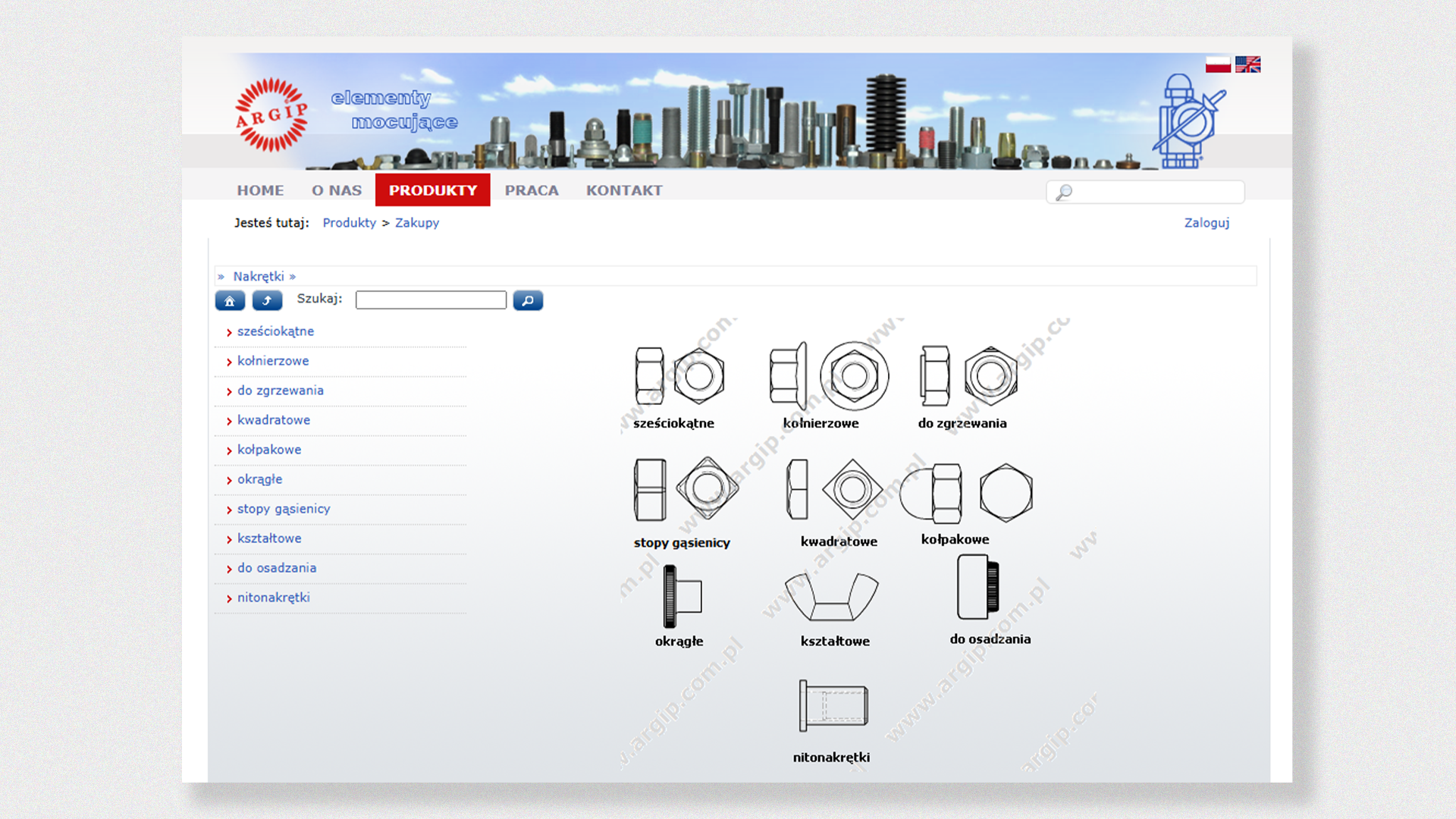
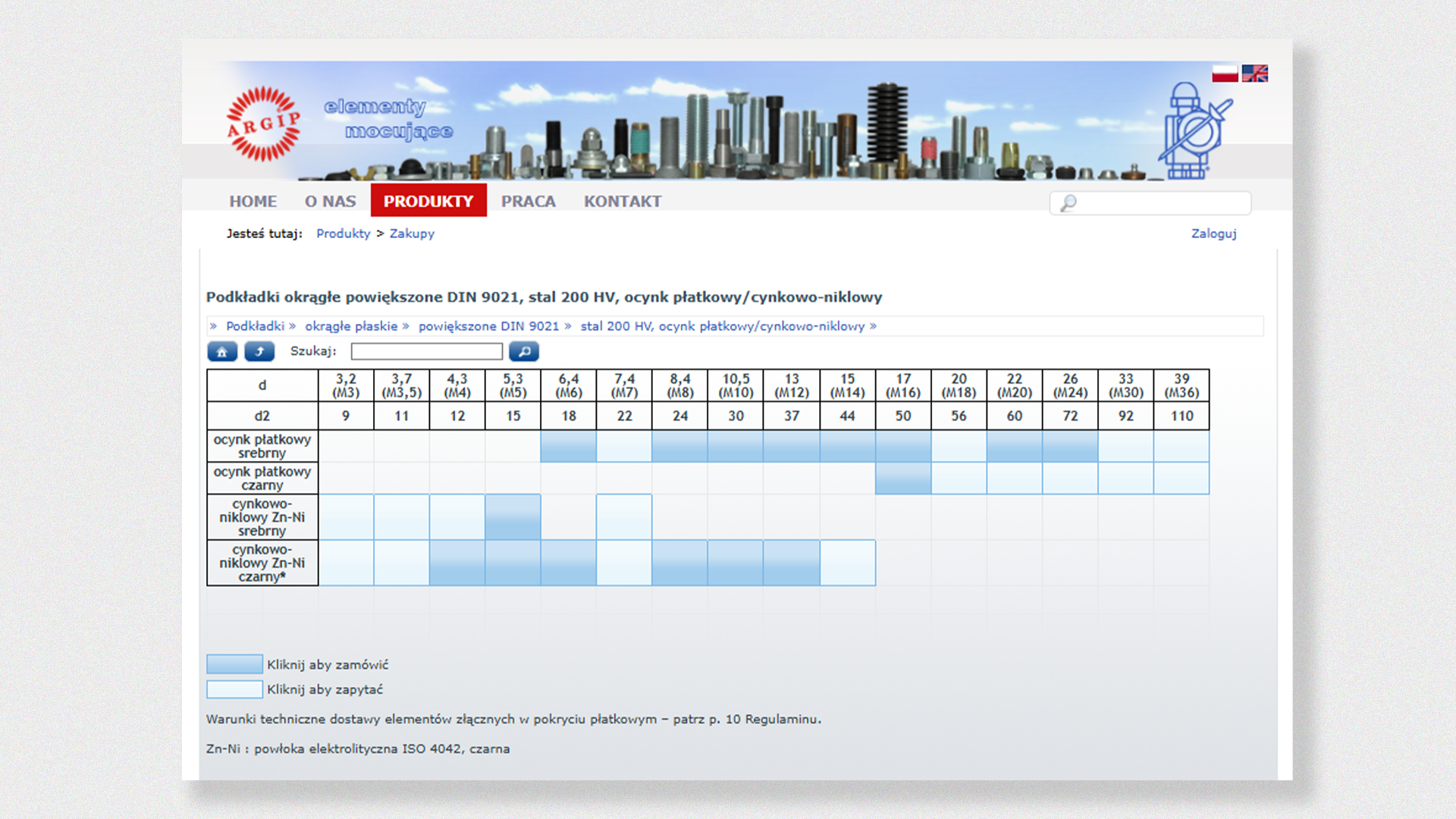
Argip before starting cooperation with Advox
Strict reflection of the actual purchasing and operational processes on the business client’s side is the main value delivered by the new technologies implemented in Argip. Warehouse mechanisms, contractors’ own indexes, the product replacement system and the handling of cyclical orders were treated as the foundation of the platform architecture, not as add-ons.
As a result, a solution was created that serves as an operational tool – supporting the daily work of purchasing and logistics departments. The store is now both an interface for placing orders and an integral part of the processes – covering information flow, stock control, settlements and compliance with ERP systems.
Designed this way, the eCommerce platform genuinely supports the business customer, providing a purchasing process that is convenient and intuitive.